Flintstones Cigarette Ad

Influence of TV

More Doctors Smoke Camels Than Any Other Cigarette

Thanks, Tobacco: You Killed My Mom

You Don't Always Die From Tobacco

SMOKE! SMOKE! SMOKE! (THAT CIGARETTE)

Graphic Australian Anti-Smoking Ad

Listen to Them Talk

The Insider - Lawyer Gets Owned

Whistleblower Protection Hearing: Jeffrey Wigand Testimony

Lung Cancer Bronchoscopy

Steve McQueen Cigarette Ad

50's Cigarette Ad

U.S. EXCERPTS: Tobacco addiction; advertising to children

Tobacco addiction

From the St. Louis Post-Dispatch

A new study published last month in a medical journal for pediatricians found that adolescents reported powerful cravings for nicotine within as few as two days of inhaling their first cigarette. They showed signs of addiction after smoking as few as seven cigarettes a month, the study found.

Some smokers argue that the increasing restrictions on smoking in public infringe on their freedom of choice to use tobacco. This new study underscores, however, that freedom and choice have little to do with it once addiction takes hold.

When it comes to young people, adolescents who take tobacco’s bait can find themselves hooked like trophy fish a lot more quickly and easily than we used to believe.

Advertising to children

From The State, Columbia, S.C.

The decision by 11 of the nation’s biggest food and drink companies to limit the way they hawk obscene amounts of unhealthy food to children is welcome news.

But before we break out the Cokes and Ruffles, a bit of perspective is in order.

Most obvious: You could drive a Twinkie truck through the loopholes in the self-imposed restrictions. The companies won’t advertise unhealthy foods on “children’s” programming, but will advertise them during such “family” shows as “American Idol,” which draw far more prepubescent viewers than many cartoons.

Worse, the rules are based on government definitions that in many cases fall far short of healthy. As The New York Times pointed out, they mean no more Saturday morning ads for Trix, with its 13 grams of sugar per serving, but business as usual for the 12-gram-per-serving Cocoa Puffs.

Sunday, April 6, 2008

Cigarette Company Paid for Lung Cancer Study


March 26, 2008

In October 2006, Dr. Claudia Henschke of Weill Cornell Medical College jolted the cancer world with a study saying that 80 percent of lung cancer deaths could be prevented through widespread use of CT scans.

Small print at the end of the study, published in The New England Journal of Medicine, noted that it had been financed in part by a little-known charity called the Foundation for Lung Cancer: Early Detection, Prevention & Treatment. A review of tax records by The New York Times shows that the foundation was underwritten almost entirely by $3.6 million in grants from the parent company of the Liggett Group, maker of Liggett Select, Eve, Grand Prix, Quest and Pyramid cigarette brands.

The foundation got four grants from the Vector Group, Liggett’s parent, from 2000 to 2003.

Dr. Jeffrey M. Drazen, editor in chief of the medical journal, said he was surprised. “In the seven years that I’ve been here, we have never knowingly published anything supported by” a cigarette maker, Dr. Drazen said.

An increasing number of universities do not accept grants from cigarette makers, and a growing awareness of the influence that companies can have over research outcomes, even when donations are at arm’s length, has led nearly all medical journals and associations to demand that researchers accurately disclose financing sources.

Dr. Henschke was the foundation president, and her longtime collaborator, Dr. David Yankelevitz, was its secretary-treasurer. Dr. Antonio Gotto, dean of Weill Cornell, and Arthur J. Mahon, vice chairman of the college board of overseers, were directors.

Vector issued a press release on Dec. 4, 2000, saying that it intended to give $2.4 million to Weill Cornell to finance Dr. Henschke’s research. Articles in Business Week and USA Today mentioned the gift. No mention was made of the foundation, begun so hastily that its 2000 tax return stated “not yet organized.”

Paul Caminiti, a Vector spokesman, confirmed that the company donated $3.6 million to the foundation over three years. The company “had no control or influence over the research,” he said.

Prominent cancer researchers and journal editors, told of the foundation by The Times, said they were stunned to learn of Dr. Henschke’s association with Liggett. Cigarette makers are so reviled among cancer advocates and researchers that any association with the industry can taint researchers and bar their work from being published.

“If you’re using blood money, you need to tell people you’re using blood money,” said Dr. Otis Brawley, chief medical officer of the American Cancer Society. The society gave Dr. Henschke more than $100,000 in grants from 2004 to 2007, money it would not have provided had it known of Liggett’s grants, Dr. Brawley said.

In an e-mail message, Drs. Henschke and Yankelevitz wrote, “It seems clear that you are trying to suggest that Cornell was trying to conceal this gift, which is entirely false.”

“The gift was announced publicly, the advocacy and public health community knew about it, it is quite easy to look it up on the Internet, its board has independent Cornell faculty on it, and it was fully disclosed to grant funding organizations,” they wrote, adding that the Vector grant represented a small part of the study’s overall cost. The foundation no longer accepts grants from tobacco companies, they wrote.

In the Vector press release, Dr. Henschke was quoted as saying that, thanks to the Vector grants, “we have raised the initial funding needed to support this important research and data collection on the effectiveness of spiral CT screening.”

Dr. Gotto said in an interview that Dr. Henschke, Dr. Yankelevitz and another colleague set up the foundation initially without the university’s approval, which he said faculty members are allowed to do. He and Mr. Mahon joined the board some weeks or months after its creation to ensure that the Vector grants were handled correctly, he said.

“If we had been approached, we would not have set up the foundation,” Dr. Gotto said. “We would have accepted the gift directly. We think we behaved honorably. There was no attempt to set up a foundation to hide tobacco money.”

Days earlier, Andrew Ben Ami, assistant secretary of the foundation, said in an interview he would not disclose the source of the charity’s financing at the request of the university.

In another interview before Dr. Gotto agreed to speak, Mr. Mahon, another foundation director, said he did not know the source of the funds.

Dr. Robert C. Young, chancellor of the Fox Chase Cancer Center in Philadelphia and chairman of the Board of Scientific Advisors of the National Cancer Institute, said he had never heard of the Vector grants. “As someone who really hung around the inner sanctum of cancer research, I have never heard anybody — anybody — ever say anything about this,” Dr. Young said.

Dr. Jerome Kassirer, a former editor of The New England Journal of Medicine and the author of a book about conflicts of interest, said he believed that Weill Cornell had created the foundation to hide its receipt of money from a cigarette company. “You have to ask yourself the question, ‘Why did the tobacco company want to support her research?’ ” Dr. Kassirer said. “They want to show that lung cancer is not so bad as everybody thinks because screening can save people; and that’s outrageous.”

Dr. Henschke’s work, while controversial among cancer researchers, has been embraced by many lung-cancer advocacy organizations, which have pushed for legislation in California, New York and Massachusetts to create trust funds to pay for lung cancer screening — often with language tailored to benefit Dr. Henschke’s group.

In New York, a bill would create a $10 million fund “to carry out lung cancer early detection research using computer tomography (CT) scanning” at a place “that was established by the multi-institutional, multi-disciplinary research program that began at 22 sites in the state in the year 1991,” a description that could only fit Dr. Henschke’s group.

But the disclosure that Dr. Henschke’s work was in part underwritten by grants from a cigarette maker will undercut those efforts, prominent cancer researchers said.

“She’s the biggest advocate for widespread spiral CT screening,” said Dr. Paul Bunn, a lung cancer expert and executive director of the International Association for the Study of Lung Cancer. “And now her research is tainted.”

Corporate financing can have subtle effects on research and lead to unconscious bias. Studies have shown that sponsored research tends to reach conclusions that favor the sponsor, which is why disclosure is encouraged. The tobacco industry has a long history of underwriting research — sometimes through independent-sounding foundations — to make cigarettes seem less dangerous.

Since 1999, Dr. Henschke has asserted that annual CT scans of smokers and former smokers would detect lung cancer when tumors are small enough to be cured, preventing as many as 80 percent of the 160,000 deaths a year from lung cancer, by far the biggest cause of cancer deaths in the United States.

Her 2006 study said that, after screening 31,567 people from seven countries, CT scans uncovered 484 lung cancers, 412 of them at a very early stage. Three years later, most of those patients were still alive, and she projected that 80 percent would be alive after 10 years and assumed that they would have died without the screens.

Critics question both her survival projections and her assumption that all would have died without screening. Indeed, most in the cancer establishment say that Dr. Henschke has yet to prove her case. CT scans have radiation risks and sometimes detect cancers that would not have progressed, leading to risky procedures like biopsies and lung surgery when not needed.

To settle the dispute, the National Cancer Institute started in 2002 the $200 million National Lung Screening Trial comparing death rates among 55,000 people randomly assigned to have CT scans or chest X-rays. Results are not expected until 2010. Dr. Henschke has asserted that allowing hundreds of thousands of people to die in the meantime is unethical.

The Cancer Letter, a newsletter, recently reported that Drs. Henschke and Yankelevitz had failed to disclose in articles and educational lectures a patent and 10 pending patents related to CT screening and follow-up. General Electric, a maker of CT scanners, licensed the issued patent beginning in 2001.

Jonathan Weil, a Weill Cornell spokesman, said Dr. Henschke did not disclose the patents in some articles and lectures because she did not deem them relevant.

On Monday, The Journal of the American Medical Association published corrections about unreported financial disclosures from Drs. Henschke and Yankelevitz. The patent and pending patents reported by The Cancer Letter “are relevant to these publications,” an editors’ note stated. Editors at the journal were not aware of Dr. Henschke’s association with Liggett, said Dr. Catherine D. DeAngelis, the journal’s editor in chief.

“I would never publish a paper dealing with lung cancer from a person who had taken money from a tobacco company,” Dr. DeAngelis said.

Universities are responsible for policing conflicts of interest and, in many cases, the required disclosures of their faculty. But Weill Cornell shared in the proceeds of Dr. Henschke’s patent and pending patents, and university officials were on the foundation board.

“We have a very strict oversight policy” for conflicts of interest, Dr. Gotto of Weill Cornell said. He dismissed any suggestion that the university could not police and benefit from faculty members’ financial deals.

But Dr. Kassirer said, “The problem is that universities, because they’re so conflicted themselves, ignore the conflicts of interest of their faculty.”

Legislation being considered in Congress would require drug and device makers to post registries of payments to doctors.

An increasing number of doctors and institutions are setting up foundations to accept money from companies without having to disclose its source, said Dr. Murray Kopelow, chief executive of the Accreditation Council for Continuing Medical Education.

“This is the third time in the past few weeks that one of these has been identified to us,” said Dr. Kopelow, whose organization is investigating how widespread the practice is.

Laurie Fenton Ambrose, president and chief executive of the Lung Cancer Alliance, a nonprofit patient advocacy group, said she still trusted Dr. Henschke and still believed in widespread CT scanning to prevent lung cancer deaths.

Tuesday, October 2, 2007

Tobacco Stains

Features > October 1, 2007

The global footprint of a deadly crop

By Bryan Farrell

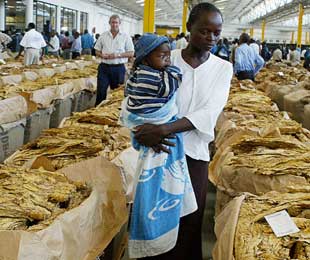
A worker inspects bales of tobacco at one of Zimbabwe's tobacco auction floors in April.


The past decade has seen a remarkable shift in the way Americans view cigarette smoking. Since the massive tobacco litigation settlements began in 1997, the federal government has phased out support for tobacco farming, states and cities have enacted public smoking restrictions, and the number of smokers has steadily declined.

Meanwhile, the tobacco industry’s manipulative advertising tactics have become part of the cultural lexicon. In the 2005 big screen satire Thank You For Smoking, the film’s protagonist—a “morally flexible” tobacco lobbyist—admits, “I earn a living fronting an organization that kills 1,200 people a day.”

With Hollywood now taking jabs at its one-time co-conspirator, it’s no wonder that the Centers for Disease Control found that 70 percent of the current 45 million adult smokers in the United States want to quit. While slightly less than half will succeed, the mere desire offers hope that cigarette smoking in America could one-day go the way of trans-fats or MSG.

Such logic, however, does not extend to the tobacco manufacturers themselves. The multinational tobacco corporations have moved their production and marketing efforts overseas, causing experts to predict that by 2010, 87 percent of the world’s tobacco will be grown in the developing world.

Since the ’60s, global production has doubled and 33 million people work cultivating tobacco to serve the world’s 1.2 billion smokers—one-fifth of the world’s population. Meanwhile, according to conservative estimates by the U.N. Food and Agriculture Organization, since 1997 consumption has increased at an annual rate of 1.7 percent in developing countries, meaning people there will smoke 71 percent of the world’s tobacco by 2010.

Deforestation and land erosion

Without even factoring in the paper wrapping, packaging and print advertisements—which require as much paper by weight as the tobacco being grown—nearly 600 million trees are felled each year to provide the fuel necessary for drying out the tobacco. That means one in eight trees cut down each year worldwide is being destroyed for tobacco production. In South Korea and Uruguay, tobacco-related deforestation accounts for more than 40 percent of the countries’ total annual deforestation. While in Malawi, in a region where only three percent of the farmers grow tobacco, nearly 80 percent of the trees cut down each year are used for the curing process.

Such a rapid depletion of trees in an already semi-arid climate will lead to desertification. Parts of Uganda are currently losing much of their arable land as the topsoil erodes.

Yet farmers in developing countries continue to grow tobacco because of the tremendous financial incentives from multinational corporations like Philip Morris and RJ Reynolds. With enticements such as farming supplies or a guaranteed foreign exchange for their crops, farmers are reluctant to use their land for anything else.

Even when some corporations try to boost their green reputation by offering to replant trees on excess farmland, most tobacco farmers use what little land is left to grow food for their families. Moreover, were farmers to stop growing tobacco and only grow food crops—as the Yale University School of Medicine proposed more than a decade ago—10 to 20 million of the world’s current 28 million undernourished people could be fed.

Aside from land erosion, deforestation also affects the atmosphere, by raising the level of carbon dioxide emissions responsible for global warming. Scientists affiliated with the climate research group Global Canopy Programme in England have reported that the 51 million acres cut down every year account for nearly 25 percent of heat-trapping gases. By that standard, the 9 million acres being deforested annually for tobacco production account for nearly 5 percent of greenhouse gas emissions.

Deadly litter

In the United Kingdom, people throw away 200 million butts and 20 million cigarette packages every day, some of which end up on the street. According to the Tidy Britain Group, cigarette butts make up nearly 40 percent of litter.

Since the filters found in most cigarettes are comprised of 12,000 plastic fibers, they are not biodegradable and can take up to 15 years to break down. Meanwhile, the leftover tobacco releases toxins into the surrounding environment.

According to Californians Against Waste, cleanup of cigarette litter costs taxpayers billions of dollars each year. Even more costly are the losses incurred from fires started by carelessly discarded cigarettes. Not only are they a major cause of forest fires—destroying wildlife and ecosystems—but they are the leading cause of fatal fires in the United States, killing more than a thousand people annually. The tobacco industry is fully capable of selling fire-safe cigarettes—wrapped with several thin bands of less-porous paper that act as “speed-bumps” to slow down a burning cigarette—but it only does so when forced by a state government. So far, only four states have such a mandate in place.

Poisoning the developing world

The deadly impact of cigarettes as post-consumer waste is one side of the story. Before being rolled and packaged, the tobacco leaf subjects humans and wildlife to numerous health hazards.

Since it is a particularly sensitive plant, tobacco often requires 16 applications of pesticides during the three-month growing period. In developing countries, where environmental laws are absent or not enforced, chemicals like DDT and dieldrin—both banned in the United States—are sprayed on the tobacco.

These pesticide applications often harm animals that live or feed near them, causing loss of biodiversity or genetic mutations. And runoff and leaching during a rainstorm carry the pesticides into waterways and aquifers, thereby contaminating the drinking supply.

Since tobacco farming requires an estimated 3,000 hours of work per year per hectacre—astonishing when compared to the 265 hours needed to produce maize—field workers endure long hours of exposure to these harmful pesticides. To make matters worse, most farm workers are in subtropical climates, where an extra layer of clothing—even if it’s for protection—could result in heatstroke. It’s no wonder that pesticide poisoning is almost exclusively a problem in the developing world, where an estimated 25 million poisonings occur each year.

Popular pesticides used on tobacco crops, such as acephate, cause twitching, headaches, salivation, diarrhea, difficulty breathing and death. A study conducted by the University of Rio Grande do Sul, one of Brazil’s largest federal universities, found that the suicide rate among Brazilian tobacco workers between 1979 and 1995 was nearly seven times greater than the national rate. They also discovered that the occurrence of these suicides corresponded with pesticide sprayings, harvests and preparation for the next year’s crop (the study admitted that its findings were not conclusive, as workers’ depression might also stem from their often insurmountable debt).

Even without pesticides, farm workers are getting sick from the nicotine their skin absorbs while handling wet leaves. This condition has come to be known as green tobacco sickness (GTS) and its symptoms include nausea, weakness, abdominal cramps, and changes in blood pressure and heart rates. While its hard to estimate the number of people suffering from GTS, one study conducted on migrant workers in North Carolina suggests that 41 percent of tobacco handlers get the illness at least once during harvest season.

Exposure to the plant and its chemicals pose a greater threat to children, increasing the risk of cancer as well as damage to their immune and nervous systems. No figures exist on the number of child tobacco workers worldwide, but many tobacco-growing countries have a history of child labor.

The Norway-based Fafo Institute for Labour and Social Research is one of the only organizations in the world to investigate tobacco-production. After researching the use of child labor on African tobacco estates—which are strikingly feudal—Fafo found that 78 percent of the children of tobacco workers between the ages of 10 and 14 work either full or part time with their parents, performing all the tasks of tobacco cultivation.

Solving the crisis

The looting of natural resources, the destruction of ecosystems, and the poisoning and enslavement of people are all reasons to end our dependence on a product that is completely unnecessary to humans. Economic alternatives to tobacco production need to be encouraged, with the goal of eradicating tobacco as a cash crop.

According to the London-based Panos Institute, which specializes in development issues, “Many crops can grow in land that is now under tobacco—they include the majority of grain crops and vegetables. Sugar cane, bananas, coconut, pineapples and cotton could all be suitable.”

Since 1999, the Golden Leaf Foundation has used funds from the settlement with cigarette manufacturers to help farmers in North Carolina transition from a tobacco-dependent economy to alternative programs like goat farming. In this respect, other parts of the world could follow America’s lead.

The fight against tobacco consumption can be won with awareness and education. The industry has suffered a massive blow to its U.S. propaganda machine. Such attacks must continue throughout the world until smoking is not just looked upon as a poor personal health decision, but one that has deadly implications for all the world’s inhabitants.

Sunday, September 30, 2007

Men who smoke risk erectile dysfunction: study

SCIENCE NEWS
September 26, 2007


Science Image:                                      A smoker lights up a cigarette near the Stade de Geneve in Geneva, August 22, 2007. Otherwise healthy men who smoke risk developing erectile dysfunction -- and the more cigarettes they smoke, the greater the risk of erectile dysfunction, according to a new study. REUTERS/Denis Balibouse
Men who smoke risk erectile dysfunction: study A smoker lights up a cigarette near the Stade de Geneve in Geneva, August 22, 2007. Otherwise healthy men who smoke risk developing erectile dysfunction -- and the more cigarettes they smoke, the greater the risk of erectile dysfunction, according to a new study. REUTERS/Denis Balibouse

NEW YORK (Reuters Health) - Otherwise healthy men who smoke risk developing erectile dysfunction -- and the more cigarettes they smoke, the greater the risk of erectile dysfunction, according to a new study.

Erectile dysfunction is the consistent inability to achieve or maintain an erection sufficient for satisfactory sexual performance. In a study of 4,763 Chinese men aged 35 to 74 years who were free of blood vessel disease and who reported that they had been sexually active within the last 6 months, the researchers found a significant statistical link between the number of cigarettes smoked and the likelihood of erectile dysfunction.

"The association between cigarette smoking and erectile dysfunction was found in earlier studies," said first author Dr. Jiang He of Tulane University School of Public Health, New Orleans. "However, most of those studies were conducted in patients with hypertension (high blood pressure), diabetes and cardiovascular disease. What distinguishes this study is that it is the first to find this association among healthy men."

Overall, men who smoked had a 41-percent greater risk of erectile dysfunction than men who did not, the team reports in the American Journal of Epidemiology.

And there was a clear "dose-response" relationship, meaning that the more the men smoked, the higher was their risk of erectile dysfunction. Compared with non-smokers, men who smoked up to 10 cigarettes per day had a 27-percent greater likelihood of erectile dysfunction ; those who smoked 11 to 20 butts a day had a 45-percent greater likelihood of erectile dysfunction; and those who smoked more than 20 cigarettes daily had a-65 percent greater chance of suffering erectile dysfunction.

The investigators estimate that 22.7 percent of erectile all dysfunction cases among healthy Chinese men - or 11.8 million cases -- might be caused by cigarette smoking.

And even when cigarette smokers quit, their risk of developing erectile dysfunction did not decrease. The risk of erectile dysfunction was statistically about the same for former cigarette smokers as for current cigarette smokers, the authors found.

"This study really has a strong message for young men," He said. "It may get their attention if they know that smoking is associated with erectile dysfunction -- even in the healthy population."

"So the message is: Don't start."

SOURCE: American Journal of Epidemiology, October 1, 2007.

Smoking Makes You Stupid


Smoking in later life seems to be linked to intellectual impairment over the age of 65, suggests research in the Journal of Neurology Neurosurgery and Psychiatry. Some previous studies have suggested that smoking may protect against of Alzheimer's disease and dementia, both of which are associated with ageing.

In a community survey of an area of North London, the research team from the Institute of Psychiatry, London, studied over 650 people aged 65 and over. Smoking and drinking habits were recorded at the beginning of the study. Their intellectual powers were also assessed. After excluding those who already had evidence of intellectual impairment, everyone else was followed up a year later to see if there was any evidence of a decline in intellect. The test used was similar to those used to screen for dementia and Alzheimer's disease.

Of the 417 people who could be retested at the end of the 12 month period, one in 16 had suffered significant intellectual decline. After adjusting for factors known to affect brain function in older people-depression, general health, alcohol use, and educational levels-the researchers found that smokers were up to four times more likely to have evidence of significant intellectual decline than either non-smokers or former smokers. Moderate drinkers before the age of 65 were marginally less likely to experience a decline in mental powers than either heavy, or non-, drinkers.

Smoking contributes to vascular disease and atherosclerosis, conditions which narrow and harden the arteries and impair blood supply to all parts of the body, including the brain, say the authors. They conclude that the lower risk among ex-smokers suggests that right through to older age, people should be actively encouraged to stop smoking to stave off mental decline.